Long before the modern spa industry existed, Thai royal courts had already perfected the art of botanical wellness. We trace the lineage of these rituals from palace to product.
o understand Thai wellness is to understand that the body and the spirit were never, in the Thai conception, separate things. The ancient healing traditions of Thailand — rooted in Ayurvedic principles brought by Indian scholars, refined through centuries of local botanical knowledge, and elevated to an art form in the royal courts of Sukhothai and Ayutthaya — were always concerned with both dimensions simultaneously. A treatment that addressed only the physical was considered incomplete.
The Origins: Sukhothai and the First Healers
The earliest documented Thai healing traditions date to the Sukhothai period (1238–1438 CE), when Buddhist monasteries served as the primary centres of medical knowledge. Monks trained in the Indian Ayurvedic tradition adapted its principles to the Thai botanical landscape, developing a distinct body of knowledge known as ตำรายาไทย (tamra ya thai) — the Thai pharmacopoeia. This system classified plants not only by their physical properties but by their elemental qualities: their relationship to wind, water, fire, and earth within the body.
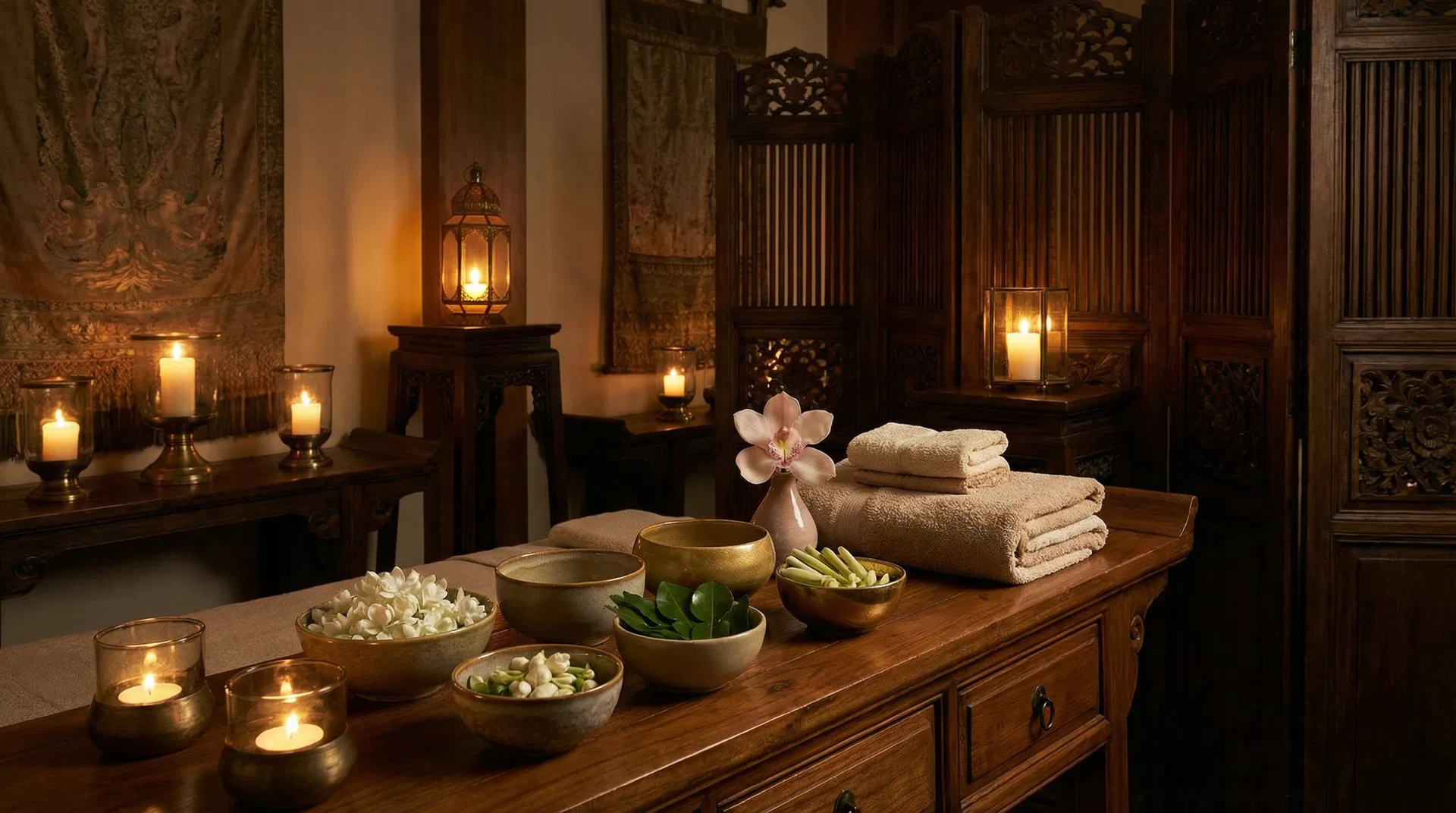
Herbal compress therapy — the practice of applying heated bundles of aromatic herbs to the body — emerged during this period as a primary treatment for muscular tension, joint pain, and what Thai healers called 'wind illness': the disruption of the body's internal energetic flow. The compresses, known as ลูกประคบ (luk prakob), were prepared with extraordinary care: each herb selected for its specific therapeutic action, the bundle wrapped in a precise pattern, the steaming process timed to preserve the volatile compounds that gave the herbs their efficacy.
The Royal Court: Wellness as Ceremony
In the Ayutthaya period, Thai wellness practices were elevated to a ceremonial art form within the royal court. The king maintained a staff of court physicians — หมอหลวง (mor luang) — who were responsible not only for treating illness but for maintaining the vitality and radiance of the royal family through regular ritual treatments. These were not merely medical procedures. They were ceremonies, conducted with prescribed protocols, specific botanical preparations, and sacred recitations.
"The royal body was understood to be a microcosm of the kingdom. To maintain its health and radiance was to maintain the health and radiance of the realm itself."
— From a study of Ayutthaya court medical texts
The botanical preparations used in these royal treatments were extraordinarily sophisticated. Court physicians maintained detailed records of formulations — some of which survive in temple manuscripts — that combined dozens of ingredients in precise ratios, adjusted seasonally and according to the individual's constitution. Kaffir lime, turmeric, lemongrass, galangal, jasmine, and ylang-ylang featured prominently, alongside rarer ingredients sourced from across the region through royal trade networks.
The Transition: From Palace to Temple to People
The fall of Ayutthaya in 1767 and the subsequent establishment of Bangkok as the new capital under the Chakri dynasty brought significant changes to Thai healing traditions. Much of the accumulated botanical knowledge of the Ayutthaya court was preserved in the temples of the new capital — most notably Wat Pho, which became the primary repository of traditional Thai medical knowledge and remains so today. The temple's famous stone inscriptions, commissioned by King Rama III in 1832, record the acupressure points, herbal formulations, and therapeutic protocols of the traditional system.
Through the nineteenth and twentieth centuries, as Western medicine gained prominence in Thailand, the traditional healing arts retreated somewhat from mainstream practice — but never disappeared. They were maintained in temples, in rural communities, and in the knowledge of family healers who passed their understanding from generation to generation. It was this unbroken lineage that the modern Thai spa industry, emerging in the 1990s, drew upon when it began to formalise and present these traditions to an international audience.
The Modern Spa and the Question of Authenticity
The global success of Thai spa culture has brought with it a tension that practitioners and brands must navigate carefully. The commercial spa industry has, in many cases, simplified and aestheticised the traditional practices — retaining their visual and sensory qualities while losing much of their philosophical depth. A treatment that was once a precise therapeutic protocol becomes a 'relaxation experience'. A botanical preparation that once required hours of careful preparation becomes a standardised product manufactured at industrial scale.
This is not a simple problem to solve. The traditional knowledge is complex, deeply contextual, and not easily translated into a commercial format without some degree of simplification. What we can do — what we attempt to do at NaturathaiJG — is to work with the tradition honestly: to understand where our formulations come from, to source ingredients with the same care that the traditional healers applied, and to be transparent about what we are and what we are not. We are not traditional healers. We are a brand that takes the tradition seriously, and that tries to bring something of its depth and intention into the products we make.
The lineage is long. From the monastery gardens of Sukhothai to the royal court physicians of Ayutthaya, from the temple inscriptions of Wat Pho to the small-batch formulation facilities of contemporary Thailand — the thread of botanical wisdom runs unbroken. We are one small part of that thread. We hold it with care.